One of the biggest misconceptions in automotive marketing is treating every impression as if it carries the same weight simply because it can be counted. In reality, impressions differ widely in influence, credibility, and longevity. Some fade the moment spend stops, while others continue working to shape perception and preference long after they are seen.
Understanding that difference is essential in a market where decisions are formed over time, not in a single moment.
To help visualize this, the framework below illustrates how different types of impressions compare in relative influence and shelf life:
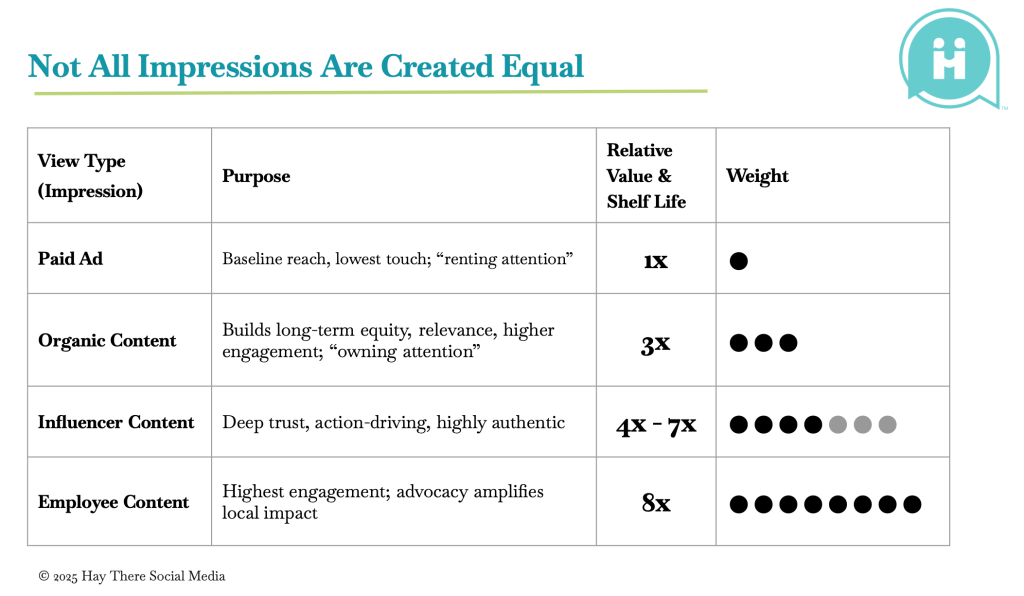
This chart is not meant to be a media plan, but rather a mental model for thinking about how different sources of visibility contribute to relevance.
Paid Ads: Baseline Reach, Lowest Influence
Paid impressions have a role, but they behave differently than other types of visibility. They provide baseline reach and help defend visibility in competitive markets, but they do so by renting attention rather than earning it. In today’s environment, paid visibility is becoming more fragile, with competition for attention increasing and paid costs rising to maintain the same level of exposure.
Research on search behavior shows that more than half of all Google searches now result in no outbound click, meaning users find answers directly on the search results page. (SparkToro Zero Click Search Study)
When users rarely click through, paid impressions and clicks become harder to earn and more expensive, because brands must outbid one another for a shrinking pool of real clicks. As a result, paid impressions are useful for momentary visibility but are limited in building lasting familiarity and trust.
Organic Content: Building Familiarity and Trust
Organic impressions behave differently. Because they appear repeatedly in everyday contexts without interrupting attention, they allow familiarity to build gradually. Over time, this repeated exposure creates recognition, comfort, and credibility. Organic content does not simply interrupt attention like an ad. Instead, it becomes part of the environment in which buyers live and explore information.
For example, a 2024 study showed that shoppers engage with an average of 15 touchpoints before converting, many of which happen outside of paid channels. (Google/PwC Shopping Study) These cumulative, contextual signals influence preference long before purchase intent is declared.
Organic impressions tend to generate higher quality engagement, contribute to long-term brand equity, and reinforce the kinds of signals that human buyers and AI discovery systems rely on. Because they compound over time, they carry significantly more value than paid impressions alone.
This is why organic social works best when treated as infrastructure, not an output. It becomes an “always on” presence that supports not only marketing, but hiring, culture, and community connection.
See how we build relevance through organic social
Influencer Content: Credibility That Accelerates Trust
Influencer impressions carry a different kind of value because trust already exists before the message is ever delivered. When content comes from local, credible voices whose audiences believe them, a dealership benefits from that existing credibility through association.
What often goes unsaid is that this discernment works both ways. Influencers are selective about the brands they align with. If a dealership’s organic social presence does not feel authentic, consistent, or relevant, meaningful partnerships are difficult to secure. Influencers are not simply amplifying messages. They are attaching their personal credibility to the brand.
When influencer content reflects real experiences rather than scripted messaging, it deepens audience trust and motivates action more effectively. Influencers extend a dealership’s reach, but more importantly, they validate it in ways that feel personal and believable.
For this reason, influencer impressions tend to carry more weight than baseline organic visibility alone. They do not replace organic social. They amplify it. Influencer content is most effective when it sits on top of a strong foundation of relevance, rather than trying to compensate for the absence of one.
Read more about our influencer approach
Employee Participation: The Highest Engagement and Longest Lasting Impact
Employee generated content may be one of the most undervalued sources of impressions, yet it is also one of the most powerful. When employees share content on social platforms, their posts are seen as more authentic and trustworthy than branded messaging because they come from real people with real networks. Research shows that content shared by employees can generate up to eight times more engagement than identical content shared through official brand channels and can reach substantially farther than company posts alone, reinforcing why employee voices carry a unique and lasting influence.
Employees are inherently trusted because they are local, human, and directly associated with the culture of a dealership. That trust matters not only to customers but to people evaluating a brand as a potential employer. A large portion of job seekers use social media as part of their research before applying for a position, with nearly 86 percent of job seekers using social platforms to inform their decisions about where to work.
When employees participate in content creation, they humanize the brand and show the personality behind the business in ways that polished corporate posts rarely can. These employee generated impressions do more than attract attention; they:
- Signal organizational culture and stability
- Build trust with customers and future hires
- Add dimension and depth to the narrative that both humans and AI systems discover and learn from
For many audiences, employee content resonates deeply precisely because it feels real and unfiltered. It does not read like traditional marketing, and that authenticity is a major reason why employee shared content often outperforms other sources.
What This Framework Means in Practice
This perspective is not about chasing arbitrary numbers. It is about understanding impact and longevity.
- Paid impressions create motion, but they do not build equity on their own.
- Organic impressions create familiarity that grows over time.
- Influencer impressions accelerate trust and widen reach.
- Employee impressions humanize and validate the brand.
When these impression types work together over time, they build relevance that compounds, not just visibility that spikes.
Not all impressions are created equal, and the impressions that matter most are the ones that keep working after the spend stops.
If you are ready to look beyond volume and understand how relevance is being built across organic, influencer, and employee content, that is where clarity begins.